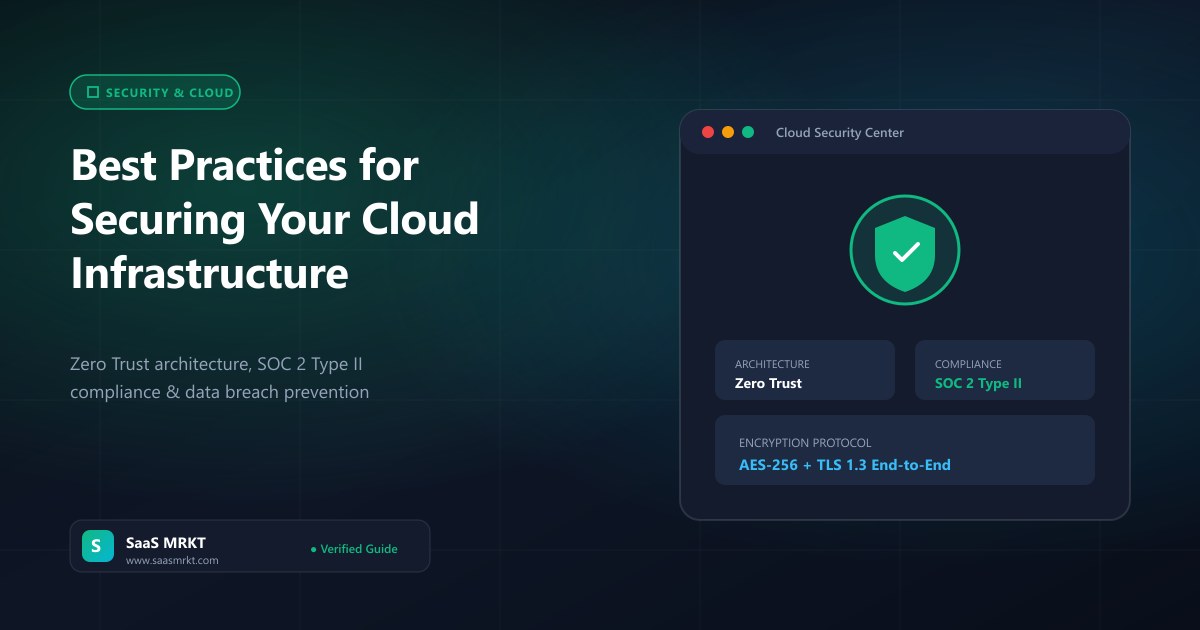
Executive Summary & Key Highlights
Data breaches are costly. Learn how top-tier SaaS companies use Zero Trust architecture and encryption to protect their most valuable assets.
The Expanding Threat Surface for SaaS in 2026
As enterprise organizations migrate critical workloads to cloud-native microservices, perimeter-based security is officially obsolete. Data breaches in 2026 cost an average of $4.88 million, with 82% of incidents involving data stored in the cloud.
Securing modern cloud infrastructure demands a defense-in-depth strategy centered on Zero Trust principles, automated compliance, and proactive vulnerability scanning.
1. Implement Zero Trust Architecture (Never Trust, Always Verify)
Zero Trust assumes that threats exist both inside and outside the network. Key implementation pillars include:
- Identity-as-a-Perimeter: Enforce hardware-backed multi-factor authentication (WebAuthn / FIDO2) and contextual session checks.
- Least Privilege Access (RBAC & ABAC): Grant just-in-time access scoped strictly to the task required. De-provision automatically after 4 hours.
- Micro-Segmentation: Isolate workloads so that a breach in a staging container cannot traverse into production databases.
2. Cryptographic Rigor: Encryption in Transit and at Rest
- In Transit: Enforce TLS 1.3 across all internal service meshes (mTLS) and external customer endpoints. Deprecate legacy cipher suites.
- At Rest: Employ envelope encryption with customer-managed encryption keys (CMEK) via AWS KMS or HashiCorp Vault.
- Data-in-Use: Explore confidential computing enclaves for sensitive tenant computations.
3. Continuous Compliance: SOC 2 Type II and ISO 27001
Enterprise SaaS buyers increasingly require verified SOC 2 Type II audit reports before signing vendor contracts. Automated compliance platforms continuously test 150+ cloud controls against AWS, GCP, and Azure configurations, surfacing drift in real time.
4. Automated CI/CD Security Gates
Shift security left by integrating static analysis (SAST), software composition analysis (SCA), and container vulnerability scanning directly into pull requests. Block deployments with unpatched CVEs with a CVSS score above 7.0.
Summary Checklist for SaaS Leaders
- Audit IAM roles and revoke unused admin privileges monthly
- Enforce strict mTLS between internal microservices
- Maintain an active bug bounty program on HackerOne or Bugcrowd
- Conduct annual third-party penetration tests with published executive summaries